

Words by Sophie Vaughan
Last month, we introduced our readers to the Summit of Sustainability Alliance (SoSA), the organization leading the way in advancing sustainability in the Summit County region through nonprofit, public, and private sector partnerships. We continue our coverage of SoSA with a deeper look into their Biodiversity program.
We spoke with SoSA Core Team Member and Secretary Pat Gsellman, who is the Senior Advisor for Akron Waterways Renewed and Senior Project Professional for Environmental Design Group. Gsellman works with Beth Vild on the SoSA Biodiversity Team to bring the UN’s Life on Land Sustainable Development Goal (SDG) to the local level, to be applicable to Summit County. The team uses the Life on Land SDG as a guide to organize activities and hopes to set goals that align with the Life on Land targets.
Gsellman explains that SoSA’s current biodiversity projects center around protecting biodiversity and natural habitats, conserving and protecting freshwater ecosystems, and integrating ecosystems and biodiversity into governmental planning. With the help of Kent State University, SoSA developed forms to assess how these current projects and activities fit under the UN SDGs, the timeframes necessary to complete the activities, and the Key Performance Indicators to ensure those goals are projecting.
In 2024, SoSA aims to set KPIs to track progress toward their project goals and overall goals. While SoSA as an overall organization goes through the process of determining metrics and KPIs, the Biodiversity team continues their diligent work to help the region realize the Life on Land SDG.
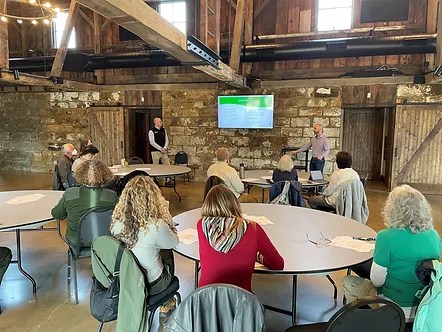
In March, SoSA held a Biodiversity Team Workshop at Himelright Lodge in Cascade
Valley Metro Park, where regional speakers and SoSA members presented on various biodiversity-related topics. The event kicked off with an introduction of SoSA by Chair Ross Widenor from Bridgestone; Vice Chair Chris Norman, MUPDD from Akron Zoo; and Secretary Patrick Gsellman, PE from Akron Waterways Renewed and Environmental Design Group. The roster was filled with local experts on biodiversity and sustainability: Chris Chaney and Janean Kazimir of Summit Metro Parks presented information on Wild Back Yards and the Importance of Understory Development; Sonia Bingham of CVNP spoke on Native Habitat Restoration; Peter Bode of Community Life Collaborative presented Collaborative Opportunities related to Environmental Social Justice; City of Akron Arborist Jon Malish presented information on the Akron State of the Canopy Report and the i-Tree Eco and Hydro tools; Akron Tree Commission Chair Sarah Vradenburg spoke about the Commission’s work; and Beth Vild from Big Love Network presented on Food Forestry and SoSA’s Spring Native Plant Distribution Event (which took place later in the spring). The workshop also included tabletop exhibits by Summit Soils and Water, Akron Waterways Renewed, Summit Metro Parks, and Cuyahoga Valley National Park.
Gsellman said that the topics covered in this workshop were the Biodiversity team’s main focus in 2022-23 and will continue to guide their work in 2024. The workshop also provided SoSA opportunities to work with Malish on the City’s tree canopy efforts and with Akron Zoo on their canopy efforts both at the Zoo and in their ward. Gsellman said that SoSA is working to support partnerships between CVNP, Summit Metro Parks and the City of Akron. He mentioned a program that Davey Tree created for the City of Akron, which SoSA is considering for possible county-wide implementation, and perhaps could even be adapted to local parks as well.
SoSA’s other Life on Land highlights from 2023 include:
- A Volunteer Day at Elizabeth Park, where volunteers planted Akron’s first public food forest, including understory plants that will provide sustainable, lasting food access to the Cascade Valley neighborhood; SoSA’s Summit Co Org2Org plant giveaway winners also picked up plants at this event and helped with planting
• A tour of the City of Akron Water Supply plant in Kent, including a presentation by Jeff Bronowski, Akron Water Supply Bureau Manager, the history of the facility, the journey of Akron’s drinking water, and the City of Akron’s work to preserve the health of Cuyahoga River watershed areas
• A virtual program by SoSA member organization Conservancy for Cuyahoga Valley National Park about the importance of green space
• A presentation on restoration of the Little Cuyahoga River by Julie Bingham, Director of Ecological Restoration and Restoration Biologist at EnviroScience
• A viewing of “Images of Eden,” which featured paintings of the Cuyahoga Valley Watershed by Julie Holman and excerpts from the book “Eden Unburied” by Scott Myers
Gsellman sees how SoSA’s work impacts biodiversity on private property, in a way that the governmental sector is unable to do. This is important, since 82% of the urban tree canopy in Akron is on private land.
“The City’s tree program is pretty much limited to just public land right-of-way — street trees, public parks, those kinds of things — but it really doesn’t get into private property at all,” Gsellman says. “And I think that doing what we did with the tree planting [event] really helps us get more into…private property.”
By following biodiversity best practices when selecting trees for their planting projects or plant giveaways, SoSA can help residents contribute toward a more biodiverse tree canopy and understory.
The Current State of Life on Land in Summit County and Where We Go from Here
Ranking #32 in the 2019 US Cities Sustainable Development Report, Akron has come a long way since the days of the burning Cuyahoga River. Local naturalists and birders can see this in the influx of otters and eagles returning to the river valley.
“We’re unbelievably fortunate in this area to have the National Park and Metro Parks,” says Gsellman. “Summit Metro Parks is very impressive in the work that they do in regards to invasive and non-native plantings.”
For example, Gsellman explains how, as part of the Gorge Dam removal project, “Summit Metro Parks is already going back into that area and removing the non-native trees that they view as being detrimental.” He clarifies that they are especially focusing on invasive non-native plants.
Summit Metro Parks also launched a new program this year called Wild Back Yards, which provides support, education and incentives for Summit County residents to plant native plants in their yards. SoSA encourages local residents to purchase their native plants through My Home Park, a web-based company specializing in Native Plant Garden sales. For customers who use the promotional code CLCMHP2023, My Home Park will donate 20% of the sale to the Community Life Collaborative (CLC) Native Plant and Canopy Program. CLC is a SoSA member organization, and this program helps to fund the Biodiversity Team’s tree plantings.
Akron’s Tree Canopy is also robust, with the most recent percentage measured at 34.1% coverage. To work toward the goal of 40% coverage, Akron Waterways Renewed has launched a 2-for-1 initiative — for every tree they remove for construction of an Akron Waterways project, they plant two trees.
In 2024, SoSA will continue its Life on Land efforts with the Biodiversity Team’s help. One major focus area will center on educating local residents on the recently passed Riparian Setback Ordinance. Gsellman has been in contact with the City of Akron Director of Public Service Chris Ludle to discuss the need for workshops or an educational series for ward meetings to inform property owners of the ordinance and prepare them for enforcement.
SoSA will also continue to emphasize understory development, which it sees as a gap in sustainability focus in the Summit County region.
“Everybody loves to plant trees, but they don’t get that excited about planting bushes, and shrubs, and underlying plants,” says Gsellman.
SoSA also wants to bring more awareness to green employment and training. Gsellman explains how in his work with Akron Waterways Renewed, they use TRY Ministries to do a lot of maintenance on their facilities. He also mentions the $1 million USDA Forest Service Urban Forestry Grant that the City of Akron was awarded for the ACORN project, noting that as part of the project, the City would develop a nursery with the help of TRY Ministries and similar organizations. These organizations would assist with planning, maintenance, and program development at the nursery, and the ultimate result would be some sort of certification. Gsellman says that SoSA will educate organizations and the public in Akron and surrounding areas to make them aware of these opportunities as they develop.
Goals, Metrics, and Getting to the Ideal State
Measuring progress toward the Life on Land SDG is complicated. Fortunately, some metrics are already available.
“The tree canopy gets the most glory, and to tell you the truth, we’re ahead of the game in regards to percentages compared to other cities of similar sizes,” says Gsellman. “I know Jon [Malish] has some specific goals as to where he wants to get it, so I think that’s being done very well.”
SoSA will also be monitoring employment in the green sector, including through Akron’s ACORN project and the Akron Waterways Renewed Program.
SoSA’s membership numbers are perhaps the easiest metric for SoSA to gauge success toward their ideal vision: which organizations have become official members, which members are sending representatives to the monthly membership meetings, etc.
As SoSA sets goals for 2024, each member subcommittee will develop activities, goals, and metrics for their individual focus areas.
So how do we get to the ideal state for biodiversity in the region? Gsellman says that education and workshops are key, with hands-on activities “to really get it to sink in.”
Gsellman says SoSA also needs to get more corporate involvement, which will also help to achieve SoSA’s overall ideal vision, with partners working together across sectors toward common sustainability goals.
“I think we’re very well represented for the non-profit and even the government sectors, but we really need to work on the corporate side of it,” says Gsellman. “I know we have Bridgestone and Cleveland Clinic Akron General, but we’re really trying to figure out how we can grow the involvement from some of the more corporate world.”
Gsellman says this corporate involvement will be especially beneficial when SoSA begins to look at other sustainability activities and other SDGs, specifically energy consumption and greenhouse gas emissions.
“I know we want to kick off the greenhouse gas initiative in 2024 and get another subcommittee started up,” says Gsellman. “That will be something to get us to the ideal state.”
SoSA will also take a deeper look at the 2019 US Cities Sustainable Development Report to see how their work might help impact Akron’s score in future years.
Once SoSA develops a stable funding structure, the Biodiversity team will have the opportunity to apply for grants to help accomplish their Life on Land goals. In the meantime, Gsellman says that SoSA hopes to streamline communications between members regarding grant funding they are receiving and how that funding could help accomplish common goals.
Gsellman is also the Web Developer for SoSA and said that the team will be making some updates to the website in early 2024, including new goals for the coming year and a list of member organizations and their representatives.
For more information on becoming a SoSA member, visit https://www.summitofsustainability.com/join.