

Words by Sophie Vaughan
What if you could pick blueberries from your local park to make a pie? Or gather chestnuts from your tree lawn to roast in your oven? What if your Sunday afternoon hike led you down a path lined with overgrown kale plants, which you could pluck for your dinner salad? That’s the reality that local permaculture expert and community organizer Beth Vild wants to grow for Akron, Ohio.
Vild is COO and Director of Programming at The Big Love Network, as well as the Founder and CEO of Wild Woman Designs and Consulting, a permaculture and landscaping design business focused on edible urban landscapes. Her decades of experience in urban permaculture and community advocacy are an invaluable asset to the Summit of Sustainability Alliance (SoSA). As a SoSA Biodiversity Team leader, Vild is ramping up for another big year of collaboration and community connection, with plans for several tree plantings, an organization-to-organization plant giveaway, and an abundance of educational outreach opportunities. This year’s activities will be informed by the successes and lessons learned from last year’s pilot projects.
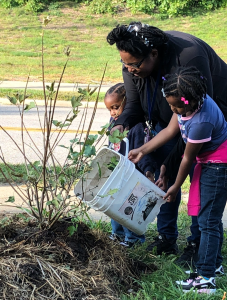
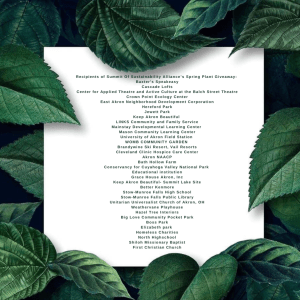
Winners of the giveaway were selected from areas in Akron with low tree canopy coverage, high rates of food insecurity, high asthma rates, and water runoff issues, as well as areas that are considered pollinator inroads from parks to go throughout the rest of the county. Of the 31 sites that received plants, 25 were forest sites, and 16 of those were food forests. 26 of the sites were planted with native plants. These sites are tracked on an interactive map that Vild created, with detailed descriptions in the captions for each point on the map.
Native AND Edible Plants
The debate about native vs. edible plants was a sticking point in the organization and planning process for the plant giveaway. Representatives from Summit Metro Parks and Cuyahoga Valley National Park were pushing for this project to focus on native plants only, but Vild saw valid reasons to push back for the plantings to include edibles that are not necessarily native to the area.
As someone who works on Environmental Health and Environmental Justice issues throughout the City of Akron, Vild knew they would be more likely to succeed in getting native plants into inner city neighborhoods if they also offered edible varieties of plants like apples and kale, which are not native to the region.
“It’s time to get back to thinking about urban landscapes as potential for agriculture,” Vild says. She mentions the historical Victory Gardens that began to pop up during World War I, when President Woodrow Wilson encouraged Americans to plant food anywhere they could find a plot, to help ward off the potential of food shortages. At the time, fruit trees were planted along the city streets, and a few remain standing today. Most of the fruit trees have since been removed, but Vild says that families still harvest crops from some of the remaining trees to subsidize their grocery bills.
Eventually, the team agreed that adding some edible, non-invasive, non-native plants into the mix would ultimately increase the overall tree canopy in areas that need it most.
Getting other organizations and government entities to follow suit is another challenge. Vild explains that city arborists are usually taught to avoid planting female trees, as they bear
fruit, and that can be messy. However, planting only male trees creates another problem.
“Using male trees is part of why we have such high asthma rates — because of the pollen that the male trees produce,” Vild says. “All that pollen doesn’t have anywhere to go without any female trees around, so it creates breathing issues in these neighborhoods.”
Vild says that advocates have had to retrain traditional experts and horticulture experts, assuring them that the trees from the giveaway were being planted by folks who were asking for them. The Elizabeth Park understory planting is the exception there, but this park is regularly maintained by the Friends of Elizabeth Park group. So, Vild says, the way to successfully plant fruit-bearing trees is to plant them in public spaces where groups are already in place to keep the area clean, and to give them to members of the community who want to plant them and harvest their crops.
Meanwhile, Elizabeth Park’s understory planting is not quite complete, for the same reasons that some of the winning sites are still awaiting plants from last year’s giveaway: securing plants from local nurseries to coincide with usual planting timelines was a big challenge due to unseasonably warm weather last February and low precipitation levels in April, followed by drought in May. When plants arrived in the fall, Vild unexpectedly gave birth to her baby early, so the remaining plantings were postponed again until spring of 2024.
Memorial Trees and New Plans for 2024
A memorial tree planting event is set to take place at Elizabeth Park on April 20, 2024 with family survivors of opioid overdose and gun violence. At that time, SoSA’s Biodiversity Team will fill in some of the previous food forest planting sites at the park with understory plants that did not make it in the ground last year during the giveaway.
Moving forward, SoSA will offer two different due dates for applications for the plant giveaway, to maximize the number of applicants. Additionally, SoSA will not guarantee the arrival of giveaway plants until Fall. Vild says this actually works out fine, since most native plants are perennials, and most perennials do best when planted in the fall, as that gives them all winter to develop their roots before creating seeds and flowers.
SoSA’s Biodiversity pilot program also included educational opportunities. SoSA hosted a Biodiversity Workshop in March 2023, but the chosen location and time of day proved difficult for community engagement, so Vild says that the half-day workshop on biodiversity turned out to be more of a conversation among experts. 30 representatives attended the workshop from the business, non-profit, education, and government sectors. The materials covered in the workshop were then distributed to over 100 local organizations.
Additionally, Vild created detailed informational packets on soil preparation practices and natural plant care techniques. This information was provided to each planting site from the plant giveaway, and Vild offered each site free consulting and design services.
Again, last year’s obstacles to the educational outreach will inform this year’s plans. There will be two educational events in February, and potentially two more in July. Time, date, and location information is still to be determined, but the goal is to hold these events in the neighborhoods where SoSA aims to give plants away, at times that will maximize community attendance.
SoSA also hopes to begin planning and raising funds for a training component of the program in 2024. Ideas for training include lessons on how to work with native plants, natural plant care without the use of pesticides and chemicals, urban permaculture and forestry programs, youth entrepreneurial training, and possibly even a permaculture certification unclass at The University of Akron.
Promoting Life on Land in Akron, Beyond SoSA
Through Vild’s work with SoSA and other local sustainability organizations, she has developed a vision for Akron.
“I’m hoping to make this not only one of the cities in the US that has the best biodiversity, but also one of the most edible cities in the US,” Vild says.
Measuring progress toward that ideal state is complicated. As SoSA went through an organizational restructure in 2018, they realized that Summit County did not have a dedicated government agency to set sustainability goals or work toward climate change. That’s why they selected the United Nations’ Sustainable Development Goals (UN SDGs) to monitor their progress. Since the UN reports on sustainability metrics in the region already, SoSA can check those reports every time they are released, to see what kind of difference they have made.
SoSA also uses Davey Tree’s iTree tool to measure the city’s tree canopy. This tool also provides metrics on the positive impacts of SoSA’s tree planting, including carbon dioxide rates, ecological benefits, air quality, and energy savings.
For Vild, metrics of success are more personal.
“I would like to work myself out of a job and help neighborhood kids in every neighborhood in the city create their own permaculture landscaping businesses,” she says.
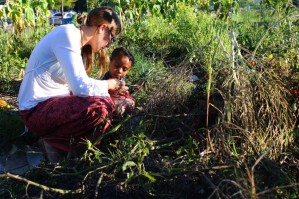
Vild sees urban permaculture as the path to help prevent future flooding and runoff issues while ensuring food security for residents. As desertification and wildfires continue across California, where most of America’s produce is grown, Vild believes we need to shift our focus toward growing our own food sustainably.
“The nationwide food import process that we have is not sustainable at all, and we have to look at what’s going to be sustainable for our region,” says Vild. “We have a great bioregion for growing our own crops and for animal management — we just don’t utilize it.”
For folks who are adamant about growing only native edible plants, Vild encourages planting elderberries, serviceberries, blueberries, paw paws, and native nuts such as chestnuts, all of which check the native box as well as the edible box.
Vild also suggests connecting farmers to the city by expanding farmers markets and farm stands. Rather than just a few farmers markets throughout the city, neighborhood farmers markets could serve each community with produce from urban farming as well as goods from the surrounding rural areas.
“I think the more that we see that, the better we’ll see people’s health outcomes, and the better we’ll see biodiversity across the county, or the region in general,” Vild says. “The more that you plant a diverse amount of plants, the more that you need local pollinators, and then you need native plants to draw the local pollinators.”
Beth hopes to educate the community on many aspects of biodiversity, such as the benefits of growing flowers alongside food.
“There is no reason you can’t have food and flowers,” Vild says. “One of the best ways to grow food is to have flowers, both for pollinators and to keep away bugs that are going to eat your food.”
This dichotomy of flowers vs. food is an example of the current state of mind for many Akronites. Vild works to help people understand the many symbiotic relationships inherent in a biodiverse ecosystem.
For instance, it’s common urban farming practice to grow only a few of each type of plant, so any damage from wildlife is detrimental. Vild has struggled to get people to understand that you can plant enough for people and for wildlife.
Take caterpillars, for example. Most people are horrified when they picture caterpillars munching away at their cruciferous vegetables or ornamental flowers. But caterpillars are the main source of nutrients for baby birds — worms provide calories; caterpillars provide nutrients. Planting native plants to host caterpillars will increase the bird population in an area, leading to a more biodiverse ecosystem.
“In food forestry, you have 100 kale plants, and sure — the groundhogs eat some of them, and the caterpillars eat some of them, but there’s still plenty enough for people,” says Vild. “So getting people’s minds wrapped around [the idea that] you don’t just need one single little understory plant that’s going to be edible, you need a whole ton of them.”
To learn more about how you can help SoSA meet their Life on Land goals, or to help plant a ton of understory plants, visit https://www.summitofsustainability.com/about-3-2.